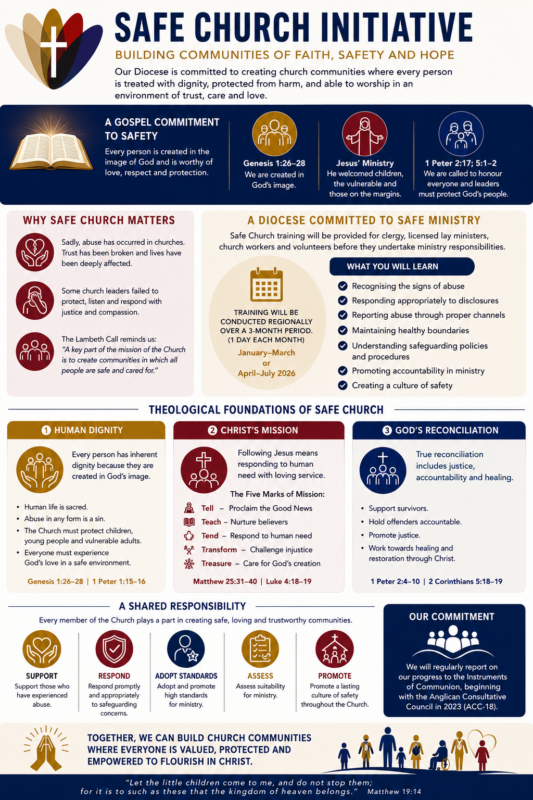

The Diocese is embarking on a comprehensive Safe Church Initiative that will equip clergy, lay ministers and church workers to create church communities where every person is treated with dignity, protected from harm, and able to worship in an environment of trust and care.
This initiative responds to the Anglican Communion’s commitment to safeguarding as outlined by the Lambeth Conference 2022, the Anglican Consultative Council’s Safe Church Charter, and the work of the Anglican Communion Safe Church Commission.
A Gospel Commitment to Safety
Safe Church is far more than a safeguarding policy or legal obligation. It is a Gospel imperative rooted in Scripture and the Christian understanding that every person is created in the image of God.
The Lambeth Conference reminds the Church that all human beings possess God-given dignity and are therefore worthy of love, respect and protection.
Genesis tells us that humanity is created in God’s image (Genesis 1:26-28), while Jesus’ ministry consistently demonstrates God’s concern for children, vulnerable people and those on the margins of society. The Apostle Peter likewise calls Christians to “honour everyone” and urges church leaders to shepherd God’s people faithfully (1 Peter 2:17; 5:1-2).
These biblical truths form the foundation of Safe Church ministry.
Why Safe Church Matters
Sadly, churches around the world have not been immune from abuse. Reports from governments, safeguarding agencies and the media have revealed occasions where trust has been broken, vulnerable people have been harmed, and institutions have failed to respond appropriately.
The Lambeth Call acknowledges these painful realities with humility, recognizing that some church workers have abused those entrusted to their care and that some church leaders failed to protect victims or respond with justice and compassion.
As bishops of the Anglican Communion declared:
“A key part of the mission of the Church is to create communities in which all people are safe and cared for.”
This commitment challenges every diocese, parish and congregation to cultivate a culture where abuse is prevented, survivors are heard and supported, and accountability is embraced.
A Diocese Committed to Safe Ministry
To strengthen safeguarding across the Diocese, Safe Church training will be provided for clergy, licensed lay ministers, church workers and volunteers before they undertake ministry responsibilities.
The training has been developed within the framework established by the Anglican Consultative Council and the Anglican Communion Safe Church Commission.
Participants will receive instruction in:
- Recognising the signs of abuse.
- Responding appropriately to disclosures of abuse.
- Reporting abuse through the proper channels.
- Maintaining healthy professional and pastoral boundaries.
- Understanding safeguarding policies and procedures.
- Promoting accountability in ministry.
- Creating a culture of safety throughout the Church.
The programme will be conducted regionally over a three-month period, ensuring that leaders throughout the Diocese are equipped with the knowledge and practical skills necessary for effective safeguarding ministry.
Theological Foundations
The Safe Church Initiative rests upon three key theological foundations identified in the Lambeth Calls.
- Human Dignity
Every person possesses inherent dignity because they are created in God’s image.
The Lambeth Call on Human Dignity reminds the Church that human life is sacred and that every individual reflects God’s love. Because of this, acts that violate another person’s dignity—including abuse in any form—are sins against God and neighbour.
The Church is therefore called to protect every person, especially children, young people and vulnerable adults, ensuring that everyone experiences God’s love in a safe environment.
- Christ’s Mission
The Lambeth Call on Discipleship reminds Christians that following Jesus involves responding to human need with loving service.
The Anglican Communion identifies the Five Marks of Mission as guiding principles for Christian life:
- Tell the Good News.
- Teach and nurture believers.
- Tend to human need with loving service.
- Transform unjust structures.
- Treasure God’s creation.
Safe Church ministry is an expression of these marks of mission. It calls the Church to respond immediately to abuse, care for those who have been harmed, and ensure that justice and compassion are central to its witness.
- God’s Reconciliation
The Lambeth Call on Reconciliation teaches that true reconciliation always includes justice, accountability and healing.
While God’s grace offers forgiveness and hope, reconciliation cannot occur where abuse is hidden or ignored.
The Church therefore commits itself to:
- Supporting survivors.
- Holding offenders accountable.
- Promoting justice.
- Working towards healing and restoration through Christ.
This balanced approach reflects God’s reconciling mission while ensuring that safeguarding remains at the heart of Christian discipleship.
A Shared Responsibility
Safe Church is not solely the responsibility of bishops or clergy. Every member of the Church shares responsibility for creating environments where people feel welcomed, respected, and protected.
The Anglican Communion calls upon churches to:
- Support those who have experienced abuse.
- Respond promptly and appropriately to safeguarding concerns.
- Adopt high standards for ministry.
- Assess suitability for ministry.
- Promote a lasting culture of safety throughout the Church.
By working together, congregations can become places where trust is strengthened, vulnerable people are protected, and every person experiences the love of Christ.
Looking Ahead
As our Diocese begins this important initiative, we do so with prayer, humility and hope. Safe Church is not simply about preventing harm—it is about reflecting the character of Christ.
When our churches are safe, they become places where children flourish, vulnerable people are protected, survivors find healing, leaders serve with integrity, and the Gospel is proclaimed with credibility.
Through this initiative, the Diocese reaffirms its commitment to creating church communities where every person is valued, every voice is heard, and every ministry reflects the love, justice and compassion of Jesus Christ.
“Let the little children come to me, and do not stop them; for it is to such as these that the kingdom of heaven belongs.” (Matthew 19:14)