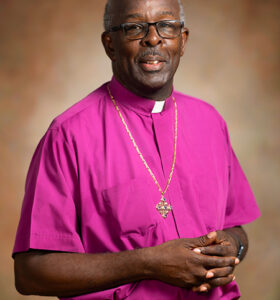
By The Rt. Rev. Leon Golding
Bishop of Jamaica and The Cayman Islands
at the Cathedral of St. Jago de la Vega, Spanish Town
September 28, 2025
The Feast of St. Michael and All Angels
Our readings for the feast of St. Michael and all Angels invite us to reflect on that unseen host, of angels and archangels and all that company of heaven, which support us in our earthly pilgrimage as the church militant. While we are conscious of our mystical union with the unseen host of heaven, and crave their continued prayerful support, I invite us to meditate on the earthly expression of the Church as the Body of Christ.
Text: 1 Corinthians 12:12-27
We are the Body of Christ.
One of the sad things about Christian witness is the division of the church at all levels. I listened to a programme recently which indicated that there are some three hundred thousand different Christian denominations worldwide. And that the number is growing. Jamaica alone we are told has more churches per square mile than any other country. The Christian witness is weakened and less effective because of our divisions.
Unfortunately, there are several causes for the division among Christians, and it is not only and always caused by the difference in the interpretation of Scripture. The text I have been led to use at this Service is not because of any division within our Diocese, but I invite us to meditate on it to remind us of our vocation as the body of Christ. The text emerged from a context in which there was division, caused by Christians aligning themselves to certain leaders within the church and from members having a sense of spiritual superiority.
The Apostle Paul no doubt mindful of Christ’s call and prayer for his disciples to be one, united, was eager to maintain the unity and wrote to the Church in Corinth. In his first letter to the Corinthians chapter 12 verses 12 to 14 he writes,
12 For just as the body is one and has many members, and all the members of the body, though many, are one body, so it is with Christ. 13 For in the one Spirit we were all baptized into one body—Jews or Greeks, slaves or free—and we were all made to drink of one Spirit. 14 Indeed, the body does not consist of one member but of many.
27 Now you are the body of Christ and individually members of it. (1 Corinthians 12: 12-14)
In every age, the Church has had to deal with internal conflicts. The human ego gets in the way of the mission of God, retarding the work, as we fight for the power and the glory.
Paul uses the human body as a metaphor for the Church. The human body has many parts and requires all its parts to work together for its proper and efficient functioning. Also, the Church, though it has many members is called by God to be one, united, with all the members working together.
Not all the members of the human body are the same. The eye is not the hand nor the hand the eye or the foot. The first thing the body metaphor highlights is that members of the Body of Christ are not all the same. If we were all the same, then the church would not be able to conduct in an effective way its function in the mission of God. We need the different charisms, gifts, and skills, for the work of ministry, for the building up of the body of Christ, and for God’s mission in the world. The Church, like the body, needs all its members if we are to be effective and efficient in conducting the work of Christ. God calls all of us and the Church needs the different gifts, talents, skills. No person or gift is to be despised.
In the body, the various parts have distinct functions. Even our unseemly parts, that we cover up and are embarrassed to expose are important and vital to the proper functioning of our bodies. Few people would choose to have those parts amputated. Paul refers to these parts of the body as the weaker ones which are indispensable.
As the various parts of the body have a function so also every member of the Church, the Body of Christ, has a role to play in the mission of God. No part is unworthy, and all are of equal value to God. The body depends on every part to function well, for it to be declared healthy.
21 The eye cannot say to the hand, ‘I have no need of you’, nor again the head to the feet, ‘I have no need of you.’ 22 On the contrary, the members of the body that seem to be weaker are indispensable, 23 and those members of the body that we think less honourable we clothe with greater honour, and our less respectable members are treated with greater respect; 24 whereas our more respectable members do not need this. But God has so arranged the body, giving the greater honour to the inferior member, 25 that there may be no dissension within the body, but the members may have the same care for one another. 26 If one member suffers, all suffer together with it; if one member is honoured, all rejoice together with it. 27 Now you are the body of Christ and individually members of it.
In the earlier part of chapter 12 Paul lists the charismatic gifts, the gifts of the Spirit. Few members of our congregations will claim to possess charismatic gifts. One of the sad things is that some of whom claim to have such gifts become puffed up and develop a feeling of superiority that leads at times to division within the Body of Christ, as was the case in the Corinthian Church. Because of the division and the air of superiority that it created rather than humility and unity in the body, Paul in chapter 13 writes of love as the gift and true character of the Holy Spirit.
There are those who may not exhibit any of the charism, spiritual gifts, listed in the New Testament, but who use their skills and talents in love towards the good of the neighbour. Certainly, this too, is a movement of God’s Spirit among us.
James in his letter calls us to acknowledge that God is the source and giver of all good gifts. He writes,
17 Every generous act of giving, with every perfect gift, is from above, coming down from the Father of lights, with whom there is no variation or shadow due to change. (James 1:17-18.)
The skills and gifts that people have obtained through studies and training that improve the quality of life for others and hold out hope for many, especially for the vulnerable among us, must be seen as God’s gifts to us. As the Church spreads the good news of God’s love, we must not exclude those with their gifts that we may not classify as spiritual, but which nonetheless can be useful in the mission of God. There are a variety of ways that God enhances the mission. As Paul states earlier in the chapter and verse 4 -7.
4 Now there are varieties of gifts, but the same Spirit; 5 and there are varieties of services, but the same Lord; 6 and there are varieties of activities, but it is the same God who activates all of them in everyone.
God works not only in extraordinary ways but through the ordinary and the faithfulness of Christians. For as Paul highlights in our text, we were all baptized by the one Spirit and drink of the same Spirit.
13 For in the one Spirit we were all baptized into one body—Jews or Greeks, slaves or free—and we were all made to drink of one Spirit.
We must embrace all God’s gifts within the body of Christ that can assist in the furtherance of the gospel. God calls all of us, and we need, and depend on all of us, as we go forward together in Christ. We are the Body of Christ.
The Church as the Body of Christ, is called to be the extension of Christ’s ministry in the world. In Jesus Christ, the holy became human and lived among us. Christian discipleship is not a call to withdraw from the world, but to engage the world. The Church exists because God loves the world. (John 3:16-17)
16 ‘For God so loved the world that he gave his only Son, so that everyone who believes in him may not perish but may have eternal life.
17 ‘Indeed, God did not send the Son into the world to condemn the world, but in order that the world might be saved through him.
We love those verses and can recite them without much thought. But do we realize the implication of them for the Church? They are the heart of the gospel and must inform the mission of the Church in the world. Jesus embraces us and the worst of us for the good of the world. In scripture, the word ‘world’ can convey two different ideas depending on the context in which it is used. At instances, it connotes that which is opposed to God and in other instances the world, all creation, is the object of God’s love.
Those who follow Christ must get involved in the business of the world. A world Christ came to save. The Church is called to embrace all people in the name of Christ for the good of our country and world. One of our recent Synods featured the theme, “God’s Church for God’s world.” This was also the theme for the Lambeth Conference as Anglican Bishops from around the globe met in Canterbury in 2022. “God’s Church for God’s world.”
Some have forgotten that God loves the world so much, especially sinners, that he gave his only Son. Greater love has no one than this.
It is an error to think that the Church is called to be a holy club withdrawn from what is happening in the world. Of course, there are those who would want the Church to remain behind closed doors in prayer, and only address the symptoms of evil, but not speak to the root causes that have implications for how people live. For the Church to do this would be for us to fail in our mandate from Christ who on Sabbath in the synagogue declared his ministry as follows,
18 ‘The Spirit of the Lord is upon me,
because he has anointed me
to bring good news to the poor.
He has sent me to proclaim release to the captives
and recovery of sight to the blind,
to let the oppressed go free,
19 to proclaim the year of the Lord’s favour.’ (Luke 4: 18)
We have just come out of a national election. The percentage turnout of the electorate was low. The Electoral Office of Jamaica confirmed a 39.5% voter turnout. The Church is called to be part of the decision-making process and not just as a critical voice. It is God’s world, and we have a role to play as stewards of all God’s gifts to us. This rock, Jamaica land we love, is one such gift to us.
The Church’s mission is to the world. The risen lord said to the early disciples,
‘Peace be with you. As the Father has sent me, so I send you. (John 20: 21)
God’s mission is not about getting people into the C hurch, it is about ransoming the world, working to restore it into a right relationship with God and neighbour. Of course, we want our congregations to grow in number, in membership, but mission is more than about swelling our congregations on a Sunday. Members of the Church are to be agents of transformation in the world.
Mission is about each of us being agents of transformation where we exercise our daily vocation. Whether we be doctors, educators, politicians, accountants, security officers, garbage collectors, or entrepreneurs, as Christians, we should champion the cause of Christ that God may reign in all the affairs of men and women. That in so doing, society would become gentler, kinder, caring, loving, and just one that reflects something of the reign of God.
The way forward for us as a Church is to embrace all God’s people for the good of the world. Praying and working for the unity of the Church is not an option for us, especially as we seek to forward the work of Christ.
I suggest further that as denominations come together to forward the work of the church, that we join with others for the good of our country and world. We must be prepared to sit down at the table with others, those different from us, to unite against the evils of our time for the good of all. We need to widen the circle for the good of all. The Church is not the only vehicle that God is working through to bring about his will.
I am prepared to collaborate with all people, Christians and non-Christians, people of faith and no faith, politicians, civic authorities, non-governmental organizations for the good of our people. Because God loves and values every human being. ***
Going forward, we must recommit to unity as a Diocese, we must collaborate with other Christian and faith traditions. We should work together with government, non-governmental organizations, and other agencies to pursue what we believe is God’s will for everyone. We do not help people through condemnation. Dialogue is more effective. It is in dialogue that the issues become clearer to us and there is a better understanding of people’s experiences and held views. We must be careful as a Church not to be too quick to condemn and demonstrate without having the facts, and hearing the other’s story.
God in Christ came into the world seeking the sinner’s cooperation. In seeking the good of all, we must seek the cooperation of all. We must widen the fellowship for God desires the unity of us all.
I believe that Sister Dolores Dufner, a Benedictine Nun, has a glimpse of what we should work towards in her now popular hymn, “Summoned by the God”. CPWI 346
The first stanza of the hymn reads,
Summoned by the God who made us rich in our diversity, gathered in the name of Jesus, richer still in unity.
The last stanza:
Draw together at one table all the human family; shape a circle ever wider and a people ever free.
And the refrain:
Let us bring the gifts that differ and, in splendid, varied ways sing a new church into being one in love and faith and hope.
We are the Body of Christ. Let us be true to the call of God, in unity and in mission Amen.
